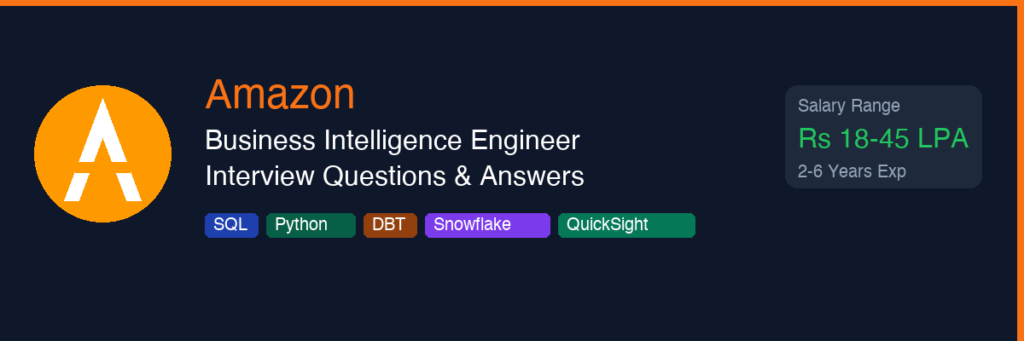
If you are preparing for Amazon BIE Interview Questions, this guide covers all four rounds — SQL, Python, business case studies, and analytics engineering (DBT, Snowflake, QuickSight) — with real questions and detailed answers used by candidates who cleared the Amazon Business Intelligence Engineer interview in 2025.
Round 1 — SQL Coding: The Heart of Amazon BIE Interview Questions
The SQL round is the most critical section of all Amazon BIE Interview Questions. Interviewers expect optimised queries using CTEs, window functions, joins, and ranking functions. Questions are medium-to-hard and are based on real analytics scenarios. Build your SQL base with our FAANG SQL Aggregation and Joins guide before the interview.
Q1 — Top 3 Products Per Category (DENSE_RANK)
Find the top 3 revenue-generating products in every category for inventory and promotional decisions.
Table: sales(product_id, category, revenue)
WITH ranked_products AS (
    SELECT
        product_id,
        category,
        revenue,
        DENSE_RANK() OVER (
            PARTITION BY category
            ORDER BY revenue DESC
        ) AS rnk
    FROM sales
)
SELECT product_id, category, revenue
FROM ranked_products
WHERE rnk <= 3;
Why this matters: DENSE_RANK() handles ties without gaps in ranking — critical for accurate top-N analytics. This is one of the highest-frequency Amazon BIE Interview Questions patterns in the SQL round.
Q2 — Monthly Active Users
Table: events(user_id, event_date)
SELECT
    DATE_TRUNC('month', event_date) AS month,
    COUNT(DISTINCT user_id)         AS monthly_active_users
FROM events
GROUP BY 1
ORDER BY 1;
Why this matters: MAU is Amazon’s core engagement KPI. DATE_TRUNC + COUNT(DISTINCT) is a mandatory combination to master.
Q3 — Running Revenue Total
Table: orders(order_date, revenue)
SELECT
    order_date,
    revenue,
    SUM(revenue) OVER (ORDER BY order_date) AS cumulative_revenue
FROM orders;
Why this matters: Cumulative metrics are central to finance dashboards and trend analysis at Amazon. Also explore our SQL CTE and Error Handling guide for advanced CTE patterns.
Q4 — Customers With Consecutive Purchases (LAG)
Table: orders(customer_id, order_date)
WITH orders_lag AS (
    SELECT
        customer_id,
        order_date,
        LAG(order_date) OVER (
            PARTITION BY customer_id ORDER BY order_date
        ) AS prev_date
    FROM orders
)
SELECT DISTINCT customer_id
FROM orders_lag
WHERE order_date = prev_date + INTERVAL '1 day';
Why this matters: Tests LAG + date arithmetic together — a classic Amazon BIE Interview Questions combination for retention analysis.
Round 2 — Python and Pandas
See our full Amazon Data Analyst Interview Questions guide for overlapping Python patterns used across Amazon roles.
Q1 — Top 5 Customers by Revenue
top_customers = (
    df.groupby("customer_id")["revenue"]
      .sum()
      .reset_index()
      .sort_values("revenue", ascending=False)
      .head(5)
)
Q2 — Missing Value Percentage Per Column
missing_pct = df.isnull().sum() / len(df) * 100Round 3 — Business Case Study
Compare case study formats across FAANG with our Google Business Intelligence Analyst Interview Questions guide.
Q1 — Amazon Prime Renewals Dropped 12%
Segment users by geography, device, and plan. Run cohort analysis to compare renewal rates across signup months. Analyze failed payment rates, pricing sensitivity, and engagement scores in the 30 days before renewal. Use funnel analysis to pinpoint abandonment steps.
Key metrics to check:
- Payment failure rate by card type and region
- Cohort renewal rate vs. prior quarters
- Device-split renewal behavior (mobile vs desktop)
- Price sensitivity by plan tier
- Support ticket volume near renewal dates
Round 4 — DBT, Snowflake and QuickSight
Q1 — DBT Incremental Model
{{ config(materialized='incremental') }}

SELECT * FROM orders

{% if is_incremental() %}
  WHERE updated_at > (SELECT MAX(updated_at) FROM {{ this }})
{% endif %}
Why this matters: Incremental DBT models cut Snowflake compute costs by 60–80% on large fact tables. A must-know pattern for any Amazon BIE interview. For full reference, see the official DBT incremental models documentation.
Q2 — Snowflake Clustering Keys
Apply clustering keys on columns used in frequent WHERE filters (date, customer_id, region). Snowflake skips irrelevant micro-partitions, reducing scan size by up to 90%. Best suited for large fact tables with billions of rows. Read Snowflake’s clustering guide for configuration details.
How to Prepare for Amazon BIE Interview Questions
- Master SQL window functions:
RANK(),DENSE_RANK(),LAG(),SUM() OVER() - Practice Pandas groupby, merge, pivot, and null handling
- Understand DBT incremental models, snapshots, sources, and tests
- Learn Snowflake clustering, query profiling, and warehouse sizing
- Prepare structured case study answers using the MECE framework
- Align behavioural answers to Amazon Leadership Principles
- Practice additional sets in our Amazon BIE question bank
- ✓ 1× Mock Interview (30 min, live)
- ✓ 1× Career Guidance session (30 min)
- ✓ 2200 Interview Questions eBook
- ✓ Ace SQL Interview eBook
- ✕ 23 eBook Bundle
- ✕ Weekly progress support
- ✓ 2× Mock Interviews (live + feedback)
- ✓ 2× Career Guidance sessions
- ✓ 2200 Interview Questions eBook
- ✓ Ace SQL Interview eBook
- ✓ 23 eBook Bundle — 2000 Qs
- ✓ Weekly progress support
- ✓ 4× Mock Interviews (every Saturday)
- ✓ 4× Career Guidance (every Sunday)
- ✓ 2200 Interview Questions eBook
- ✓ Ace SQL Interview eBook
- ✓ 23 eBook Bundle — 2000 Qs
- ✓ Weekly progress tracking